_(50533254208).jpg/1280px-Cades_Cove_Campground%2C_October_24%2C_2020_--_Warren_Bielenberg_(1)_(50533254208).jpg)
A campsite is the cheapest room in the national parks and still the best one. For $10 to $36 a night you sleep inside the gates, you get the trailhead before the day visitors do, and you keep the park after they leave. What you no longer get, at least in summer, is spontaneity. The famous campgrounds now release their sites months ahead on Recreation.gov, and the good ones go in minutes.
The Park Service lists 156 units with camping, from a 432-site machine on Yellowstone Lake to five tent pads on a Maine island you reach by mail boat. The full directory is below, with fees, filters and live alerts. First, the ten parks worth planning an entire trip around.
The ten best national parks for camping
01Yellowstone
Yellowstone fees, hours and campgroundsTwelve campgrounds and more than 2,000 sites, and the best odds in the system of unzipping your tent to bison. The scale is the point. Bridge Bay alone holds 432 sites on Yellowstone Lake, and even the small loops feel like the middle of nowhere: Slough Creek's 17 sites in wolf country, Tower Fall's 33 near the canyon.
Booking runs on two tracks. The five big concession campgrounds (Canyon, Bridge Bay, Grant Village, Madison, Fishing Bridge RV) go through Yellowstone National Park Lodges, which opens its calendar on the 5th of each month for the same month of the following year. The Park Service loops (Slough Creek, Lewis Lake, Tower Fall) run on Recreation.gov's six-month rolling window, and Mammoth goes first-come from October 15 to April 1. One change worth knowing: starting with the 2027 season, the big five move to Recreation.gov too.
02Yosemite
Yosemite fees, hours and campgroundsThe hardest camping reservation in America, and still worth the fight. Sixteen campgrounds, thirteen of them reservable, and the Valley's Pines loop (Upper, Lower and North, 391 sites between them at $36) puts you under the cliffs with the shuttle at the loop entrance. Tuolumne Meadows adds 309 sites at 8,600 feet when the high country opens in July.
Everything releases at 7 a.m. Pacific: most campgrounds five months out on the 15th of each month, half of Tuolumne in a separate two-month drop, the rest of it 14 days ahead. The Park Service itself warns that spring and summer dates sell out within minutes, which is not an excuse but a scheduling instruction. Camp 4, the tent-only climbers' camp that more or less invented modern rock climbing, is listed on the National Register of Historic Places, and at $10 a shared site it remains the cheapest sleep in the Valley.
03Glacier
Glacier fees, hours and campgroundsThirteen campgrounds strung along the Going-to-the-Sun Road and its side valleys, with the sharp end of the Rockies outside the tent flap. The reservation campgrounds (Apgar, Fish Creek, St. Mary, Many Glacier, Two Medicine, Sprague Creek, Avalanche) book on Recreation.gov, most sites six months out, with a slice of each campground held back for a four-day release at 8 a.m. Mountain for the spontaneous. The small lakeside loops stay first-come: Bowman Lake's 48 sites up a gravel road, Kintla Lake's 13 on the North Fork. Fees run $15 to $30 a night.
04Grand Teton
Grand Teton fees, hours and campgroundsThe Tetons simplified camping by ending the argument: every campground in the park is reservation-only now, all of it on Recreation.gov, six months out. Jenny Lake's 61 tent-only sites at the base of the range are the classic get and price accordingly ($56). Colter Bay's 360 sites are the pressure valve at the north end, and Gros Ventre's 322 sites on the sage flats catch the overflow. No timed entry, no entrance reservation, just sunrise on the range from your sleeping bag.
05Acadia
Acadia fees, hours and campgroundsFour campgrounds and one of the stranger release calendars in the system: 90 percent of sites drop six months ahead on the first of each month at 10 a.m. Eastern, and the last 10 percent two weeks out. Blackwoods (292 sites) sits in the spruce a short walk from the ocean cliffs. Seawall (202) takes the island's quieter western side, and Schoodic Woods (89) leaves the crowds behind across Frenchman Bay. Duck Harbor's five sites on Isle au Haut require a mail boat from Stonington and a certain commitment, and reward both.
06Zion
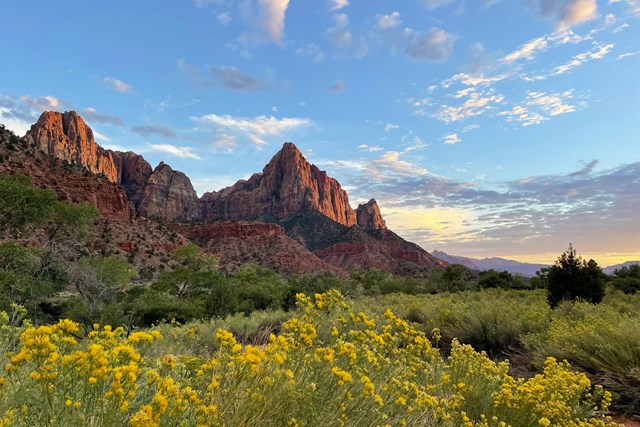
Zion fees, hours and campgroundsWatchman (190 sites, $35) is a five-minute walk from the visitor center and the canyon shuttle, the Virgin River along one edge and its namesake spire filling the windshield. It books six months out and fills accordingly. South Campground next door releases only two weeks ahead, the system's built-in second chance. Lava Point's six sites, an hour up the Kolob Terrace Road at 7,890 feet, trade the shuttle lines for silence at $25.
07Great Smoky Mountains
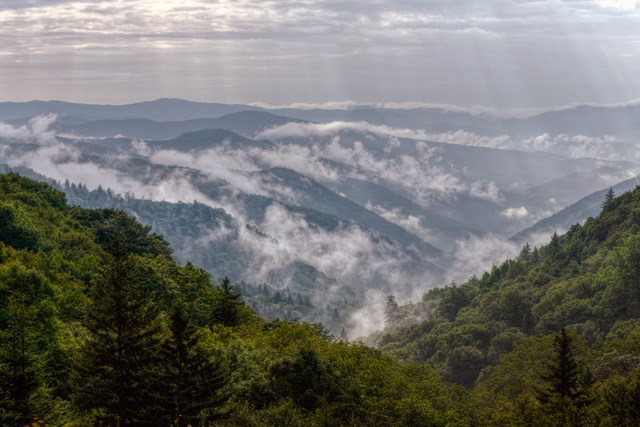
Great Smoky Mountains fees, hours and campgroundsThe most-visited national park in the country (11.5 million visits in 2025) and it doesn't charge an entrance fee. What it does charge for, it books out: all ten developed campgrounds are reservation-only year-round now, first-come is gone, and sites release six months ahead. Elkmont (217 sites, $30) sits in the old logging townsite with the June firefly show. Cades Cove (161) puts you inside the famous loop before the cars stack up. Cataloochee (27) is the elk valley. Abrams Creek (16) is the small one.
08Olympic
Olympic fees, hours and campgroundsThree parks in one, and the camping matches. Hoh (89 sites, $24) puts you inside the rain forest under the big maples, reservation-only from June 12 to September 6 and first-come the rest of the year. Kalaloch books its bluff above the Pacific for the May-to-September season, while South Beach just south keeps the same ocean first-come. Mora and Fairholme round out the reservable set, and the small loops up the valley roads (Graves Creek, North Fork, Queets) stay old-school.
09Joshua Tree
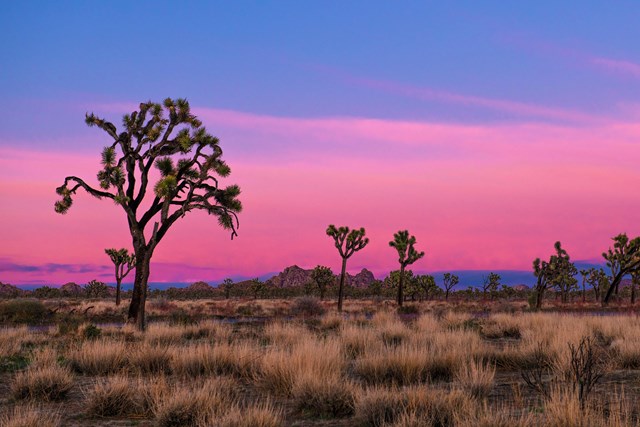
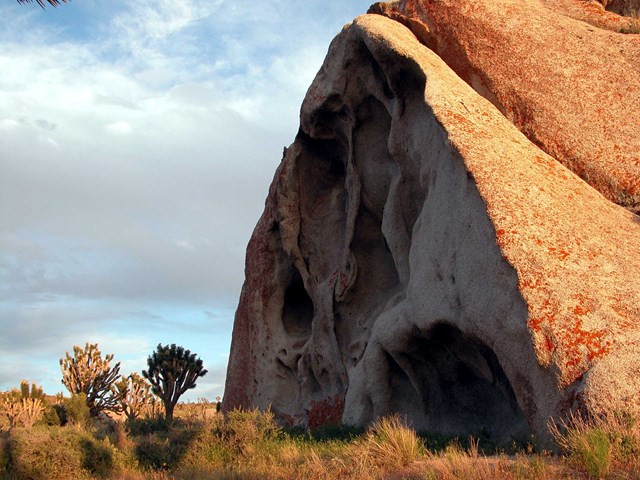
Joshua Tree fees, hours and campgroundsAbout 500 sites scattered among the boulders, most of them bookable from six months out to the same day. Jumbo Rocks (124 sites, $30) is the classic, campsites tucked into the rock piles, and Black Rock (99, $35) and Indian Cove (101, $35) anchor the edges. The season runs October to May. Summer brings triple digits, partial campground closures, and a park-wide campfire ban from June 15 to October 1, which is the desert's way of telling you to come back in November. The dark skies are the point. Joshua Tree is a designated International Dark Sky Park, and the Milky Way shows up on schedule.
10Grand Canyon
Grand Canyon fees, hours and campgroundsMather Campground in South Rim Village is the workhorse: open all year, shuttle at the entrance, pines between you and the rim, bookable six months out. Trailer Village next door is the full-hookup RV option, and Desert View, 25 miles east, trades the village for the rim's quieter end. The news is on the other side. The North Rim Campground, closed with the rest of the North Rim after the 2025 Dragon Bravo Fire, reopened June 1, 2026 and books through October 15: fewer services, 1,000 feet higher, a different canyon.







How national park camping reservations work
Every park campground books through Recreation.gov or a concessionaire, and every facility sets its own calendar. The default is a six-month rolling window: your July 14 site appears on January 14, usually at 7 a.m. Pacific, and the famous ones are gone by 7:05. The parks under the most pressure have built their own schedules on top of that default, and knowing yours is half the sport.
Yosemite releases on the 15th of each month, five months out. Acadia drops 90 percent of its sites six months out on the first of the month and holds 10 percent for two weeks ahead. Yellowstone's concession campgrounds open a whole month of the following year on the 5th. Glacier saves a slice of each campground for a four-day release. Zion's South Campground books only two weeks out. The Great Smoky Mountains ended first-come camping entirely.
| Park | When sites release |
|---|---|
| Yosemite | The 15th of each month, five months out |
| Acadia | 90 percent six months out on the first of the month, 10 percent two weeks ahead |
| Yellowstone concession campgrounds | A whole month of the following year on the 5th |
| Glacier | A slice of each campground held for a four-day release |
| Zion, South Campground | Two weeks out |
| Great Smoky Mountains | Reservations only, no first-come camping |
The old way survives in pockets. Olympic's rain-forest loops go first-come outside the summer reservation season, Devils Garden all winter, Death Valley's big gravel flats year-round, Glacier's small lake campgrounds, Yellowstone's Mammoth from October to April. The first-come playbook hasn't changed since your grandfather's: arrive mid-morning on a weekday, catch the departing campers, ask the ranger at the entrance what's open.
The full walkthrough is in our guide to how camping reservations actually work. The parks that currently require timed entry just to drive in, a separate system from camping, are on the reservations page.
How to actually get a site
- 1
Know your exact release. Each campground's booking window and release time are listed on its Recreation.gov facility page. Set an alarm for five minutes before, with the account created, payment saved, and your second and third choices already open in other tabs.
- 2
Book the week you can get, not the week you want. An anchor night in the right campground beats a perfect plan with no site. You can adjust once you're in the system.
- 3
Chase the second drops. The 14-day and 4-day releases exist for people who missed the first one, and cancellations repost to Recreation.gov the moment they happen. Check with breakfast.
- 4
Shift the calendar, not the park. Midweek, and May or October instead of July, changes the odds more than any trick.
- 5
Play first-come correctly. Mid-morning on a weekday, as the previous night's campers pull out. Ask at the entrance station instead of circling loops.
- 6
Keep a backup outside the gate. Almost every big park borders national forest, where dispersed camping is generally free and forest campgrounds catch the overflow. Book the forest site as insurance, then hunt the in-park cancellation.
A short history of camping in the parks
Camping built the national parks as much as the parks built camping. In May 1903, Theodore Roosevelt spent three nights under canvas in Yosemite with John Muir, snow on the ground, and came home arguing that the valley belonged in federal hands. The idea that a park was a place you slept in, not just looked at, stuck.
The campground itself never really changed. Access did.
The automobile made it mass culture. In 1924 Yellowstone counted 144,158 visitors, and 100,186 of them arrived in 30,689 private cars, camping in roadside auto camps that were crowded, chaotic and increasingly organized. The parks responded by building the template you still recognize: loops, pads, a fire ring, a comfort station. The Civilian Conservation Corps spent the 1930s adding water systems, roads and timber-and-stone campground buildings across the system.
The postwar boom nearly broke it. Visitation went from 11.7 million in 1945 to 47.8 million in 1954, onto infrastructure built before the war, and Mission 66, the Park Service's ten-year rebuilding program, answered with the modern campground: bigger loops, trailer pads, dump stations. The reservation era came last. Phone queues in the 1990s became a website in the 2000s, and Recreation.gov turned the first morning of the booking window into a competitive event. The campground itself never really changed. Access did.
All 156 parks with camping
Below is every Park Service unit with camping in the official record, from full-service campgrounds with showers to a patch of gravel and a vault toilet. Filter by entrance fee, check the alerts before you drive, and click through for each park's campground list with site counts, hookups and rig limits.
Free to enter Charges an entrance feePoints are the Park Service reference point for each unit, not a boundary.






































_(50533254208).jpg)
Keep planning
- Camping in national parks: how reservations actually workThe full release-window playbook.
- Timed entry, explainedThe parks that require a reservation just to drive in.
- Which parks require reservations right nowThe live list.
- How to plan a national park road tripCorridors, pass math and windows.
- The best time to visit a national park, by park typeWhen each kind of park works.
- Backcountry camping in the parksWhen the campground isn't far enough.