.jpg/1280px-Skier_in_Lassen_Volcanic_NP_(18020872041).jpg)
The parks ski best when they close. Once the snow stakes go up and the plows stop, the same roads that carried summer traffic turn into groomed, gliding trail systems through empty country - usually no lift lines or day tickets, and the occasional geyser erupting at the trail's edge. The Park Service lists 52 units with skiing, and the category is wider than it looks: cross-country tracks, backcountry touring, and in a couple of parks, actual downhill.
This page is the general guide. If you want prepared tracks, the cross-country page goes deeper. Downhill needs its own explanation here: not every park listed for skiing has a ski hill. The ten below are places where skis change what the park is. The full directory follows.
The ten best national parks for skiing
01Crater Lake
Crater Lake fees, hours and alertsThe rim road that circles America's deepest lake is never plowed in winter, which converts it into one of the best ski tours in the country: roughly 30 miles of gentle grade along a caldera rim, with the lake appearing and disappearing through the hemlocks. Strong parties ski the full loop over three or four days with a backcountry permit; everyone else skis out West Rim Drive for the view and comes back for lunch. The park marks routes from easy forest glides to the full rim, the snowpack averages in the hundreds of inches, and the season runs well into spring. It is the rare ski trip where the scenery is doing the work and the terrain just politely agrees.
02Yosemite
Yosemite fees, hours and alertsWinter turns Yosemite into two parks. Down at Badger Pass sits the oldest downhill ski area in California, where the West's first lift - a 1933 contraption called the Upski - helped start the region's ski culture, and a family-sized mountain still runs lifts and rentals. Up the closed Glacier Point Road, the first five miles are groomed for cross-country during the winter season, and the road beyond leads to Glacier Point on a 10.5-mile ski trail with views of Half Dome and the high country. The Ostrander Ski Hut is a separate overnight trip toward Ostrander Lake, not a hut at Glacier Point. Crane Flat adds gentler tracks through the big trees. Summer's traffic jam, gone.
03Mount Rainier
Mount Rainier fees, hours and alertsParadise lives up to the name year-round, but in winter it is the Northwest's original ski hill: Seattle skiers were racing the Silver Skis here from 1934 into the 1940s, hiking up for one long run in an era before lifts. The lifts are gone and the skiing is better for it - Paradise and the roads above Longmire are now touring and snowshoe country, with some of the deepest recorded snowpacks on Earth as the base. The 14,406-foot mountain does the decorating, by the 2025 remeasurement. Check the road status before you drive; Paradise is famously the place where the snowplow is the most important vehicle in the fleet.
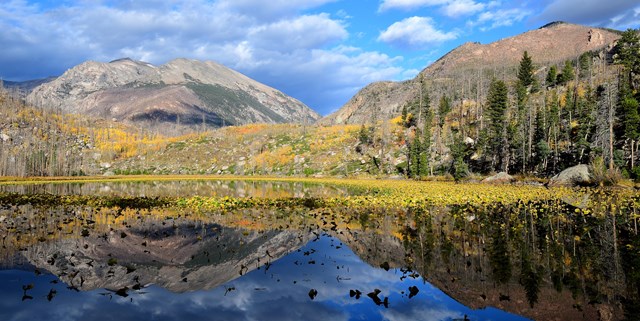
04Rocky Mountain
Rocky Mountain fees, hours and alertsThe park once had its own ski area - Hidden Valley operated inside the boundary until 1991 - and the old slopes remain as open glades that touring skiers and sledders share each winter. The cross-country action centers on the Kawuneeche Valley's gentle terrain on the west side and the trails out of Bear Lake on the east, all of it at 9,000 feet with the Continental Divide for a wall. This is high, cold, thin-air skiing; the park's timed-entry system sleeps for the winter, and the crowds drop from thousands to dozens. The elk do not seem to notice the skis.
05Yellowstone
Yellowstone fees, hours and alertsFrom mid-December to mid-March, Yellowstone's interior belongs to skis, snowshoes and the tracked oversnow coaches, and the geysers keep their appointments regardless. The classic day is a ski from the Old Faithful area out the ungroomed trail to Lone Star Geyser or through the Upper Geyser Basin, steam rising through cold air, bison standing in the runoff like statues with opinions. West Yellowstone and Cooke City flank the park with hundreds of miles of groomed trails on the doorstep. It is the only ski trip on Earth where the trail hazards include thermal features, and the park's winter map is a genuinely different document from its summer one.
06Grand Teton
Grand Teton fees, hours and alertsWhen the snow arrives, the Park Service stops plowing the Teton Park Road beyond Taggart Lake Trailhead, and the roadbed becomes a rolling ski trail pointed straight at the Grand. Skiers and snowshoers take the road to the frozen lakes - Taggart and Bradley are the classic destinations - while the backcountry behind them holds serious touring up into the range's canyons. The Moose-Wilson Road joins in, the elk concentrate on the valley floor, and the whole park goes quiet in a way summer visitors would not believe. Flat, scenic, and as photogenic as skiing gets without a chairlift.
07Acadia
Acadia fees, hours and alertsRockefeller built 45 miles of broken-stone carriage roads to keep motorcars away from his island, and a century later the Acadia Winter Trails Association's volunteers groom them for cross-country skiing - the only national park trail system groomed by a volunteer ski crew. The roads climb gently through spruce and over the famous stone bridges, with the ocean showing through the trees, and the skiing is as civilized as the engineering. Some sections stay open to snowmobiles by rule; the groomed set-tracks are posted park by park. It is New England estate skiing, and the estate is a national park.
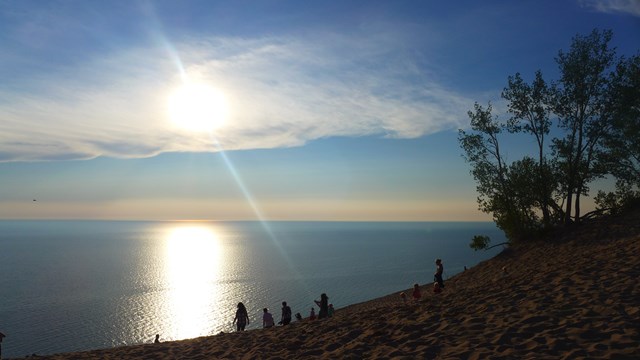
08Sleeping Bear Dunes
Sleeping Bear Dunes fees, hours and alertsLake Michigan dumps the snow, the dunes hold it, and the lakeshore grooms the trails - a combination that makes this the best cross-country skiing in the lower Midwest. Marked loops run through maple-beech forest and along bluffs above the frozen lake, with set tracks for striding and room to skate. The famous dunes themselves are for looking, not skiing - the steep faces are off-limits to protect them - but the Pierce Stocking drive and the inland trails deliver the views without the damage. Winter is the park's smallest season and, locals will tell you, its best.
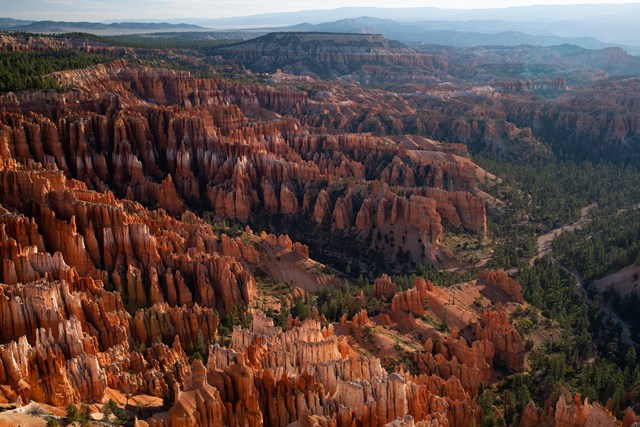
09Bryce Canyon
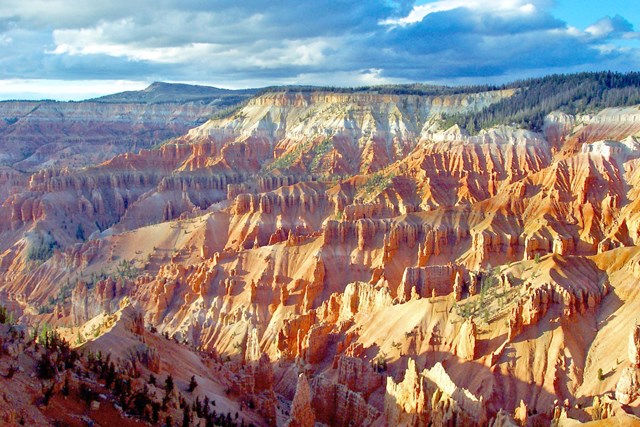
Bryce Canyon fees, hours and alertsThe one-sentence case for skiing Bryce: red hoodoos under fresh snow, at 8,000 feet, with no one around. The rim above the amphitheater carries gentle cross-country terrain through the pines, and the park marks winter routes along the edge with the whole eroded fantasyland below. Downhill it is not - the canyon itself is closed to skiing for obvious reasons - but as a half-day of gliding with the best view in Utah, it has no competition. Winter is Bryce's secret season: the snow stabilizes the crowds down to a trickle and the air turns crystalline.
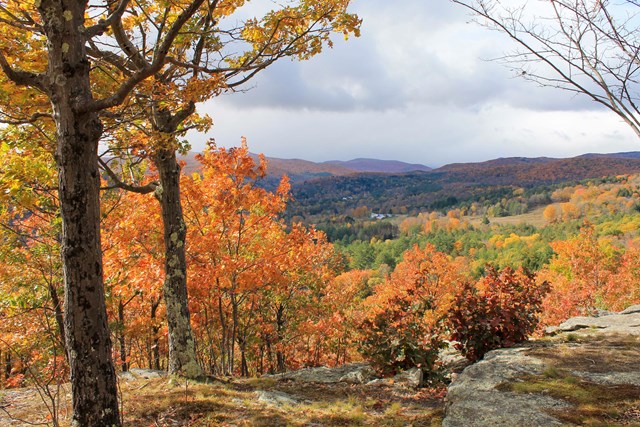
10Marsh-Billings-Rockefeller
Marsh-Billings-Rockefeller fees, hours and alertsVermont's national park of conservation history doubles as its most civilized ski venue: the carriage roads up Mount Tom, built for summer carriages, groom into perfect winter tracks through managed forest with views to the Ottauquechee valley. The one detail to know before you drive up: the grooming is not the park's. The Woodstock Inn and Resort Nordic Center holds an easement on the park's carriage roads and maintains and grooms more than 12 miles of them as part of its own network, so skiing or snowshoeing the groomed trails requires a Nordic Center day ticket or season pass, bought at the center on Route 106 (walkers get about 4 miles of marked multi-use corridors free). The terrain is gentle, the grooming is real, and the mansion and farm at the base handle the hot-chocolate end of the day. It is the smallest park on this list and the only one where the ski trail is itself the exhibit - a working forest, managed for 150 years, that you happen to be gliding through.






Downhill skiing: where the lifts actually run
Olympic's Hurricane Ridge is a small winter operation with lift-served skiing, snowboarding and a tubing hill, subject to staffing, weather, the road and snow. The park has warned that the ridge lacks an indoor warming area, food service, potable water and gear rental after the lodge fire. Vehicles must carry chains or approved traction devices when the winter road rule is in effect. Check the current park and operator status before driving up.
Great Sand Dunes offers sandboarding and sand sledding, not a snow resort. Ordinary snow skis work only on unusually wet sand, so bring sand-specific equipment if sliding is the goal. The smaller dunes take a walk from the main lot and every run means climbing back through loose sand. This is not a lift-ticket alternative. Fort McHenry has no ski hill; do not go there expecting a downhill run.
Yosemite's Badger Pass is another real lift-served ski area. If your trip depends on a lift, confirm Badger Pass or Hurricane Ridge's current operation before setting out.
When to go: a skiing year in four decisions
Early winter is a moving target. Badger Pass and Hurricane Ridge depend on snow and road access; an old season announcement is not a new one. Check the operator and NPS status before buying tickets or loading skis. At a higher park, the entrance road may be the day's limiting factor.
Midwinter favors established access. Acadia carriage roads and the Woodstock Nordic Center groom when conditions permit; Yellowstone's interior follows its oversnow travel rules. A road closed to cars can become a good ski route, but it can also be closed for weather. Read the park's current notice.
Spring lengthens some tours. Crater Lake can keep snow long after nearby towns have none. But a warm afternoon can change surface and avalanche conditions. Plan the return as carefully as the outbound miles.
Summer is for choosing next winter's route. Check whether your ski destination requires a concessionaire ticket, a backcountry permit or just park entry. Marsh-Billings-Rockefeller's groomed trails use the Woodstock Nordic Center pass; not every park ski trail is free merely because it is inside a park.
How winter access actually works
- 1
Check the day's road and snow report. Mountain parks follow conditions, not a fixed opening date. A grooming map from last winter cannot tell you whether the access road is open today. The park-alert guide is a good start.
- 2
Choose a route within your skills. A marked, groomed carriage road and a backcountry ski slope are different trips. Carry avalanche training and gear for avalanche terrain, or stay on terrain suited to your preparation. A park boundary is no safety rating.
- 3
Confirm rentals and tickets before arrival. Badger Pass operates lifts and rentals when open; check Hurricane Ridge's latest notice for gear rentals and warming space. The Woodstock Nordic Center requires its own ticket to ski its groomed park trails.
- 4
Plan the turn-around. Winter daylight, a closed gate and changing snow can make a scenic road tour much longer on the return. Pack layers, food and water and tell someone the route. The empty road is the point, not a guarantee of help nearby.
A short history of skiing the parks
Park skiing is older than ski lifts. Mount Rainier's Paradise meadows drew Seattle's ski clubs in the 1910s and 20s, when the sport meant hiking up for one run; by 1934 the Silver Skis race down from Camp Muir was a marquee Northwest event. Yosemite answered in 1928 with a ski school, then in 1933 with the Upski - the West's first mechanical lift, a cable-pulled sled rather than a modern chairlift - and for decades the parks hosted genuine ski hills, complete with carnivals, Olympic hopefuls and winter lodges.
The middle of the century sorted the experiment. The big resorts grew up outside park boundaries where expansion was allowed, and most in-park ski areas - Hidden Valley at Rocky Mountain lasted until 1991 - quietly closed. What replaced them suited the parks better: the unplowed road became the trail, the carriage road became the track, and skiing returned to what it was in the 1910s - the best way to move through a winter landscape quietly, now with grooming.
All 52 parks with skiing
Below are Park Service units that list skiing. Not every park has a downhill facility. Check fees, road conditions and operator status before treating a listing as a ski-day plan.
Free to enter Charges an entrance feePoints are the Park Service reference point for each unit, not a boundary.

















.jpg)